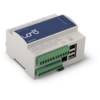
Features
Mounting:
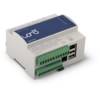
6 modules DIN rail case
power supply, serial and I/O connections on pluggable terminal blocks
Power supply:
10-50Vdc power supply, with surge and reverse polarity protection, and 3.3A resettable fuse
integrated uninterruptible power supply (UPS), with external lead-acid 12V or 24V battery (reverse polarity and over-current protection)
software-controlled auxiliary 12-24Vdc stabilised supply output, to power external devices through Iono Pi Max UPS
software-controlled auxiliary 5Vdc stabilised supply output
voltage and current monitoring of power supply input, battery and auxiliary supply outputs
Processing cores:
Raspberry Pi Compute Module version: 3, 3 Lite, 3+ 8GB, 3+ 16GB, 3+ 32GB, or 3+ Lite
ATSAME54 32 bit microcontroller, with 1 MB program memory and 256 KB RAM
The microcontroller is interconnected to the Raspberry Pi via I2C, USB and CAN. It can take direct low-level control of all serial ports and digital/analog I/O
Connectivity:
standard RS-232 interface to the Raspberry Pi serial line, up to 115200 bps
standard RS-485 interface, routed to the Raspberry Pi serial line or USB, with opto-isolator and electrostatic discharge protection, up to 115200 bps
Controller Area Network (CAN) V2.0B and CAN-FD interface, support speeds up to 8 Mb/s, with opto-isolator and electrostatic discharge protection
5V-level, protected, I2C expansion bus
10/100 Ethernet port
2 x USB 2.0 type-A ports, with power control and fault detection
internal USB 2.0 type-A port, with power control and fault detection, to embed USB dongles inside the enclosure
High reliability and security:
witchable dual microSD card architecture
hardware watchdog, fully independent from the Raspberry Pi Compute Module, controlled via GPIO, with dual SD card switch control
real time clock (RTC) with replaceable back-up battery
embedded Microchip ATECC608A secure element chip
internal temperature sensors for system temperature monitoring
internal fan, with automatic activation based on current load and internal temperatures
integrated Serial Wire Debug (SWD) interface to the microcontroller, allowing in-field firmware upgrades, but also development and debugging, directly from the Raspberry Pi
Inputs/Outputs:
4 x power relay outputs rated for 6A at 250V, with NO and NC contacts
4 x open-collector outputs
2 x analog outputs 0-10V or 0-20mA
4 x analog voltage inputs 0-20V
4 x analog current inputs 0-20mA
2 x Pt100 or Pt1000 temperature sensor inputs
4 x digital input lines 0-40V
4 x digital 5V-level I/O lines, with 1-Wire and Wiegand support
More:
front-panel RGB LEDs for power supply and serial line activity, can also be directly controlled by the Raspberry Pi
on-board piezoelectric buzzer
front-panel push-button, connected to a GPIO pin
optional earthquake sensor module